The endoscope bending section is the short, flexible segment near the distal tip that allows physicians to steer through curved anatomy. When this component fails, angulation becomes stiff or unresponsive, directly affecting procedure quality. Understanding its structure helps you identify problems early and reduce repair costs.
Structure and Working Principle
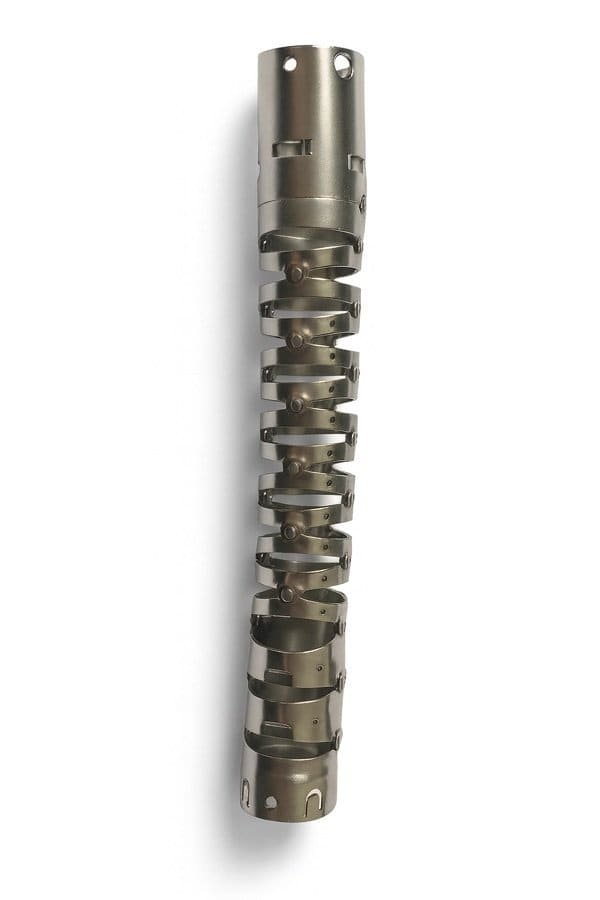
The bending section sits between the insertion tube and the distal tip. It converts rotational input from the control knobs into multi-directional tip movement. The assembly has 4 main components working together.
Interlocking metal rings form the backbone. These stainless-steel or nitinol rings connect to each other through pivot pins. Each pin is offset 90 degrees from the adjacent one. One set of pivots enables up-and-down movement. The other set enables left-and-right movement. Together, they allow the tip to curl in any direction.
Four angulation wires run through the insertion tube and attach to the bending section tip at the 3, 6, 9, and 12 o’clock positions. When the endoscopist rotates the up/down knob, it pulls the wire at 12 o’clock (up deflection) or 6 o’clock (down deflection). The left/right knob works the same way with the 3 and 9 o’clock wires. Rotating both knobs simultaneously produces combined movements.
A braided mesh sleeve surrounds the ring assembly. This fine stainless-steel or polymer mesh protects internal components from abrasion and prevents kinking.
The bending rubber (elastomeric boot) covers the entire assembly. It seals the ring stack against fluid ingress and provides a smooth surface that prevents tissue pinching during angulation. Because it must remain thin and flexible, the bending rubber is one of the most vulnerable parts of the endoscope.
Common Damage Types and Their Causes
The distal end accounts for approximately 45% of all endoscope damage, according to Olympus service data. The bending section is particularly susceptible because of its mechanical complexity and exposure during procedures.
Bending rubber tears and punctures are the most frequent issue. The rubber is thin by design, making it vulnerable to cuts from biopsy forceps, snares, and contact with the control handle’s sharp edges. Squeezing too tightly when wiping down the scope can also cause “bunching,” which leads to creases and small tears.
Angulation wire degradation occurs over time through normal use. A 2016 study by Rozeboom et al. in Endoscopy International Open evaluated 20 colonoscopes and 5 gastroscopes from 3 Dutch hospitals. The results were striking: only 10% of colonoscopes reached the manufacturer-specified maximum tip angulation. None of the gastroscopes met spec. The study also found that recent maintenance checks did not significantly improve performance, suggesting that standard servicing may not fully restore wire tension.
Fluid invasion follows bending rubber damage. When tears or holes allow moisture into the bending section, it can reach the CCD/CMOS sensor and cause image degradation. Fluid invasion accounts for approximately 25% of all endoscope damage. Signs include image staining, clouding, or condensation under the lens. AAMI ST91:2021 requires leak testing before every reprocessing cycle to catch these failures early.
When to Replace the Bending Section
Not every problem requires a full bending section replacement. Here is a practical decision framework.
| Symptom | Likely Cause | Typical Action |
|---|---|---|
| Visible tear in bending rubber | Rubber wear or puncture | Replace bending rubber |
| Stiff angulation in one direction | Stretched or frayed wire | Angulation adjustment or wire replacement |
| Angulation loss greater than 30 degrees from spec | Multiple wire degradation | Bending section rebuild |
| Failed leak test at bending section | Rubber breach or mesh damage | Inspect and replace damaged components |
| Image clouding or condensation | Fluid invasion through bending area | Immediate repair to prevent sensor damage |
Timely replacement of the bending rubber or minor angulation adjustments can prevent the more expensive consequence: fluid invasion reaching the image sensor. A bending rubber replacement typically costs a fraction of a full bending section rebuild. The key is to act on early warning signs rather than waiting for a complete failure.
Regular inspection of the bending section should be part of your pre-procedure checklist. Pay attention to angulation response, rubber integrity, and leak test results. A brief manual check of tip deflection before each procedure can flag problems that standard maintenance may miss. When replacement parts are needed, choosing quality-verified bending section components ensures reliable angulation performance and extends the service life of your endoscopes.
References
- Rozeboom, E.D. et al. “Evaluation of the tip-bending response in clinically used endoscopes.” Endoscopy International Open, 2016; 4: E466–E471.
- ANSI/AAMI ST91:2021. “Flexible and semi-rigid endoscope processing in health care facilities.” Association for the Advancement of Medical Instrumentation.
- Mariani, L. “Avoiding the Broken Endoscope Blues.” Gastroenterology & Endoscopy News, June 2019.
